Looks cool 
I’ve started to clash my head on Ifc… It’s quite hard.
Yoi did mention you were interested in separating it from Arch objects. So… How am I supposed to act? Shoud I add a preliminary support to the new wall and window using the current workflow? Should I start something different keeping prototype new objects as clean as possible?
What do you think?
import FreeCAD
import FreeCADGui
from FreeCAD import Rotation, Vector

App = FreeCAD
EPS = 0.002

VZOR = App.Vector(0, 0, 0)
ROT0 = App.Rotation(0, 0, 0)
I suppose that this things are sufficient, the other variables are needed for the rotation part, but in this code there is non need to rotate anything, so VZOR is for a Zero Vector and ROT0 stand for FreeCAD.Rotation(0,0,0) much more readable ans short.
maybe even :
import FreeCADGui
Is not needed
Plus, maybe Part_box is more tailored, but you have to replace with a placement as the base using the my method is constructed directly around the Z axis.
But there are many way to do things, but as the Placement is the more difficult if you have to do multiple rotations, as a copy don’t preserve the original placement, it may not be what you want.
Generally a placement is “retained” if you move the components in place before to make another operation like boolean operations, so if you plan to fuse or cut is better to move them prior in a manner that preserve your “reference point” in the place you are most comfortable to use in a second time.
Box is the more strange, apart from wedge, every other object use a more cmnfortable “reference point”.
But maybe is only a matter of taste.
As using App in place of FreeCAD, this is not a good way, if you import FreeCAD, and then import:
from FreeCAD import Rotation, Vector
non need to redefine:
VZOR = App.Vector(0, 0, 0)
ROT0 = App.Rotation(0, 0, 0)
This is a habit generated from the code when it separate the interface importing somewhere in the initialization code:
import FreeCAD as App
import FreeCADGui as Gui
I think this is a workaround to mantain the logical separation between FreeCAD that mostly if not entirely use OCCT and the internal definitions and FreeCADGui that is using Coin3D and is related to the Gui part, and to have more shorter code.
I think there is non need to reassign:
App = FreeCAD
Another things why import Part module on every method?
Regards
Carlo D.
Hey there!
I’ve simplified it more: https://github.com/yorikvanhavre/BIM_Workbench/blob/master/archobjects/window_presets.py
It’s not necessary to create a new placement and assign it when you just need to move something up by 5mm. Just change shape.Placement.Base.z 
Part is imported on every module for lazy loading. We avoid importing big modules on the top of the file (cause they are loaded on startup), so BIM workbench loads faster (according to yorik).
# BEGIN DOC Settings
DEBUG = True
DBG_LOAD = False
DOC_NAME = "finestra"
# END DOC settings
This code is not useful anymore, it relates to “my way” of settings things.
Godd hint the “Placement.Base.”.
Regards
Carlo D.
It’s not really a big problem for the BIM WB, because you as a user choose to install it, so it doesn’t harm every other FreeCAD user, but the BIM WB is really beginning to take time to load… Several seconds here. So I began to give it some optimizing.
That late loading is really important. It’s a fundamental design decision of FreeCAD, and also matter of respect for other users too. We don’t make loading time of others worse because we want something better for ourselves. We need to constantly keep optimizing FreeCAD. It’s a complex and heavyweight application, and each little bit of additional weight here and there multiplies and makes things slower. Of course that is not just about late loading, but it has its part to play there. Many commercial apps use the late loading concept too.
I’m replying here for the other thread too where you complained about this @carlopav I understand everybody wants nicer code, but I don’t think this should ever come at the cost of performance. Of course I agree the json module is lightweight and can go to the top. But some modules just cannot go to the top. And IMHO if we anyway can’t get a clean, ideal solution where all imports are nicely organized to the top of the file, there is no really big gain in being picky here…
But I won’t start a flame war over this either, if these things are so important to you guys, I’ll take care of putting as much as possible to the top. But my opinion is that little by little we are harming overall responsiveness. and this will need some workaround at some point in the future
+1!
I don’t remember complaying about that  (and I’m keeping this stile with BIM too)
Oh sorry, it was @vocx who complained, not you
Sorry for the intrusion, importing the Part module I think is not a big problem, it is the “base” ot FreeCAD, or not?
Not counting that every line that is not a comment is parsed and so it is using some time, maybe a very little time to be executed.
One caveat, is to time the execution, (only for testing pourpose), it could be done simply putting some var that store the actual time and then printout the difference from the preceding time, is very easy to do and to use and can reveal some bottleneck, maybe in some “plain” codes.
I think I have read something about python execution speed somewhere, but i don’t remember well where, let me search and maybe we will find some hints.
First Hit could be useful?
https://wiki.python.org/moin/PythonSpeed/PerformanceTips
There is some test for the import in a function versus the general import speaking in terms of performance under Import Statement Overhead
another find:
https://pybit.es/faster-python.html
Hope it will help
Regards
Carlo D.
I don’t think so. It’s just one module as another.
Freecad can run without the part module, but you will need it if you want to use OCC.
But you can perfectly want to use other libraries.
At least that’s what i’ve understood.
Edit: So for example you may want to use a draft Text from the Draft module, that do not use Part. If the import of Part is at the beginning of just one of Draft modules, importing Draft will load Part, and this could slow down importing Draft for a user that do not want to use OCC shapes. Again, at least this is what i’ve understood
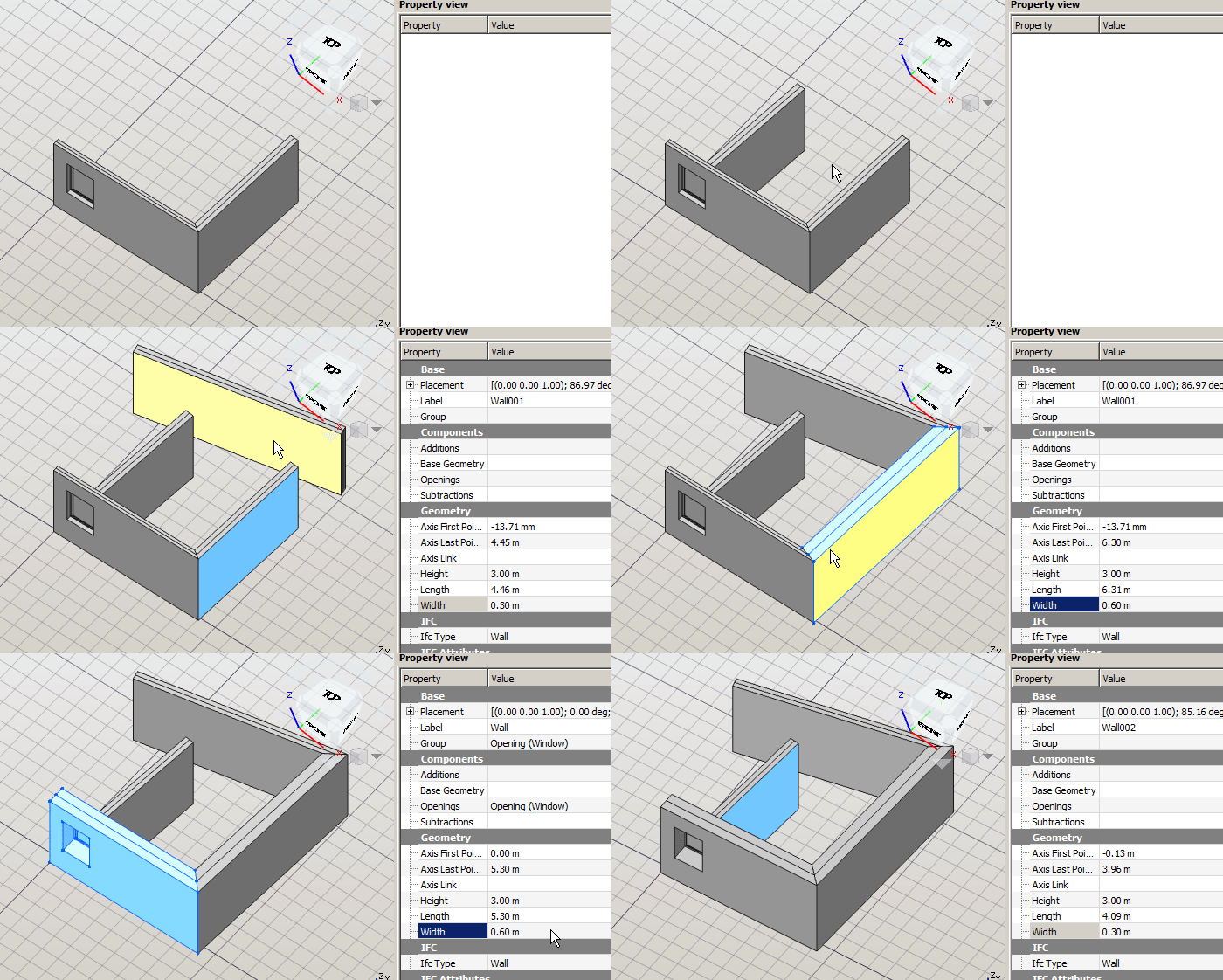
It has been a while since I was posting a gif 
The prototype has been improved with auto updating opening elements when width changes, and also auto recomputing end joinings.
Yes, it seems a reasonable approach, but OCC is the base of every solid you create with FreeCAD, only text and maybe mesh is not using the Part module.
From what i know if a module is already loaded, it is not loaded twice, but the overload of having python to check if the module is loaded is more demanding than loading it and maybe (I’m almost sure that Part is used in a manner or other in FreeCAD, as it have no sense of using a CAD without using CAD features).
A test will surely stop every discussion, time the execution of the same code, loading Part at the beginning, and time the execution using it on every method and the considerations are easily done.
From some reading I have done, importing a module in a method is discouraged.
Regards
Carlo D.
I think this is a delicate topic, and if we want this convention to be changed we should prove it with several tests. From my side my programming skills are not sufficient to have an opinion, so I’m fine with both approaches.
Nice progress.
P.S. Using Assembly 4 alike workflow (attaching CS), for constructing beam structures. Maybe that could be explored in the future too.
Thanks!
Sure thing! probably beams and pillars ar also more suitable than walls for having an own coordinate system.
What i’d like to start experimenting with (also if yorik do not agree  ) is to bring LCS to the building part (or better to use plain App::Part with some added properties instead of a dedicated object).
Attaching would be cool, but at the moment i’d prefer keeping object not too intelligent (at least dumber than me)
Looking forward.
By the way, it would be nice if you try those experimental tools and give us a feedback, they are already into the BIM workbench marked with a red star.
Go for it with App::Part @carlopav! I don’t pretend to know thing better than anyone else 
I started with App::Parts too, but the hassle of adding/removing objects to/from them and dealing with coordinate changes was so annoying to me that I ended up going another path. But you might find a better way.
About importing modules inside methods, all I read everywhere (and also experienced myself) is that once you load a module, it stays loaded globally (it is added to the globals of the python interpreter session), and further imports don’t reimport anything, so it is safe to import a same module hundreds of times, it will be actually loaded only the first time, you’ll see that statement everywhere on the net…
All I can find is that it is considered ugly and not recommended for code cleanliness reasons. But IMHO if it has an impact on performance, performance must come first. And I think we could mitigate the issues, for ex. group all the imports cleanly at the top of each method…
Yup, let me scratch the itch!
My main concern ATM is trying to merge the current wall tool, any suggestions on that? I want to keep things simple.
I don’t think we should go that way. You will unnecessarily add unwanted heritage stuff. I’d rather follow your way, and add what you need to your wall object. Then we can progressively retire the current one…
I would say for me what it should have is material layers, I would suggest basing that on Arch Multimaterials because that’s what many other Arch objects use, but it’s up to you, and be exportable to IFC with correct extrusion and maybe baseline/axis.